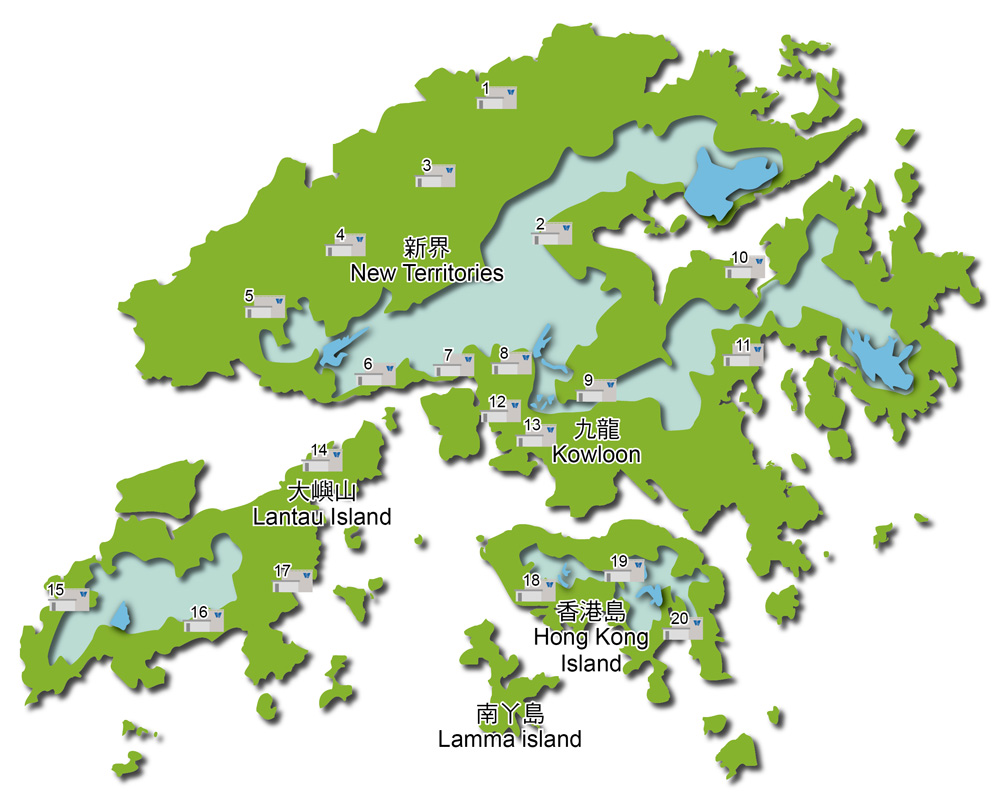
Location of Water Treatment Works in Hong Kong
Hong Kong’s water comes from two sources: from rainfall collected in local catchments and from the Dongjiang in Guangdong, Chinese Mainland. For the raw water to become drinking water, it has to undergo a series of treatment processes to ensure that the treated water is in full compliance with the Hong Kong Drinking Water Standards.
Hong Kong has 20 water treatment works with a total production capacity of 4.68 million cubic metre of potable fresh water each day.
Location of Water Treatment Works in Hong Kong

Raw water entering a conventional water treatment works goes through a series of treatment steps.
Various chemicals may be added into raw water as pre-treatment to facilitate the subsequent treatment process:
To coagulate the particles to form large flocs that can be removed. Different technologies of clarification are used, which include:
Multi-deck sedimentation
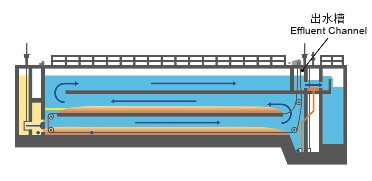
Constructed as three-tray tank to save space.
High rate lamella sedimentation
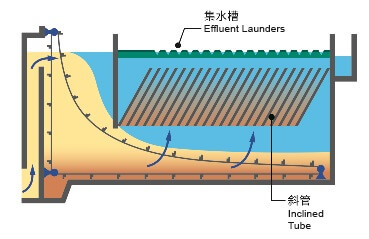
Impurities settle more quickly to the bottom via the inclined tube installed in the tank.
Solids contact clarification

Remove impurities through mixing to facilitate aggregation and settle to the bottom.
Dissolved air flotation (DAF)
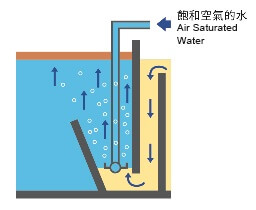
Impurities adhere to tiny bubbles formed by dissolving and releasing air in the water and then float to the surface where they are removed.
To remove the more finely divided flocs by “Gravity Filtration” or “Biological Filtration”.
Rapid Gravity Filtration
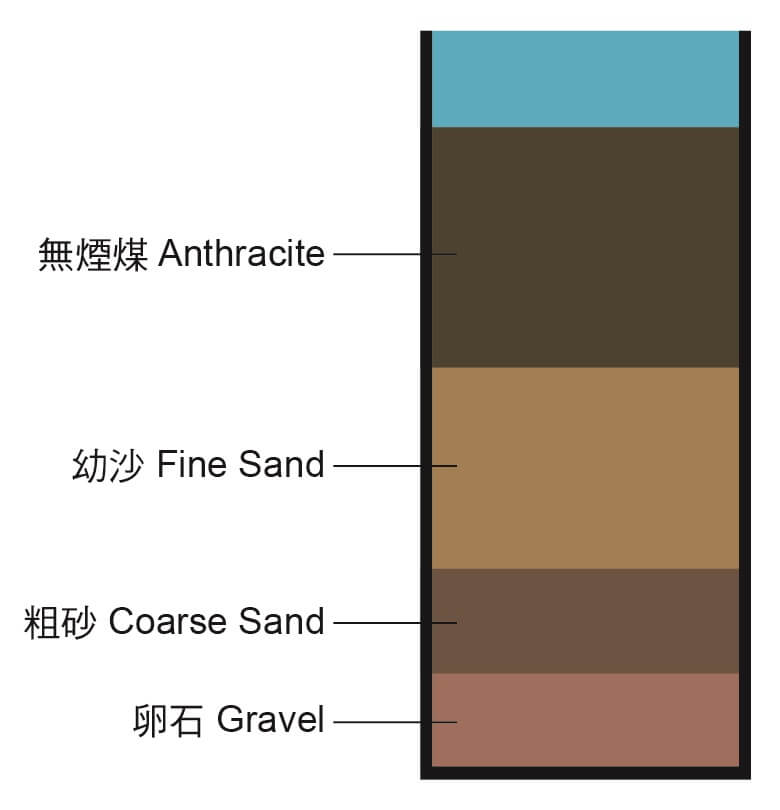
Use anthracite, sand and other granular media to remove more finely divided suspensions.
Biological Filtration
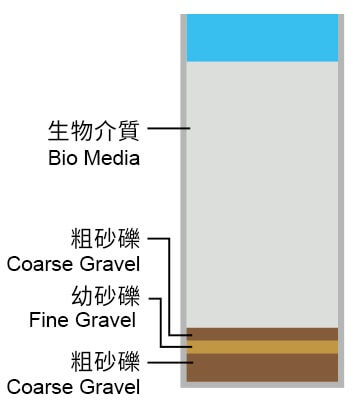
Use bio media, sand and other media to remove more finely divided suspensions ammonia and organic matters.
The filtered water is disinfected by adding chlorine/hypochlorite or ozone in contact tank.
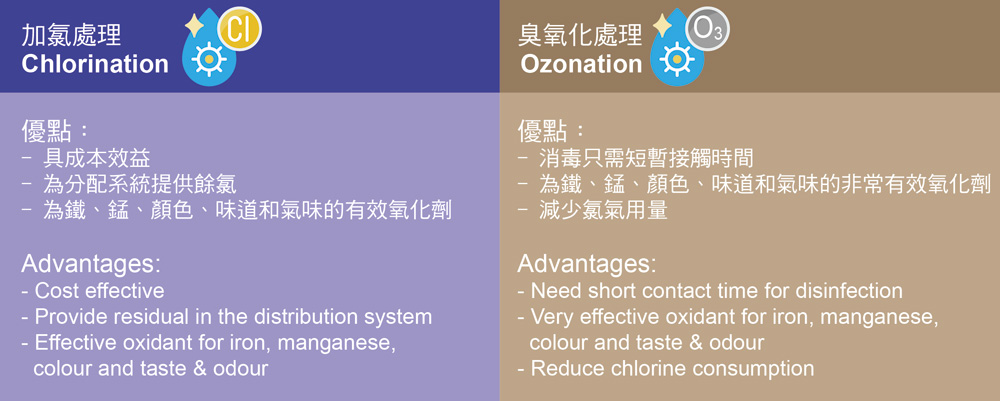
After disinfection, the treated water is fit for human consumption. It will then be conveyed to service reservoirs pending consumption by the public. A small amount of residual chlorine is maintained in the water to prevent bacterial growth in the rest of its journey. Fluoride is also added for dental protection.
The game “Water Treatment Processes” makes use of simple diagrams to introduce the water treatment process of raw water.