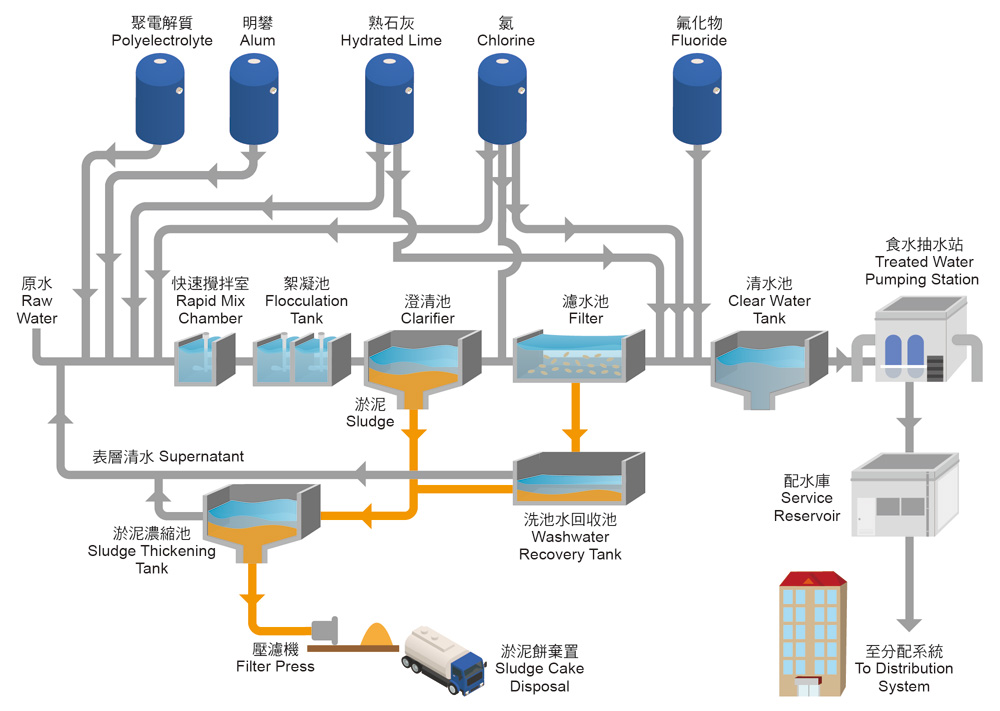
Typical Water Treatment Process
Water usually requires purification before it is safe to drink. This involves the removal of soil particles, impurities and waterborne microorganisms. As a result of the stringent and thorough treatment process and water quality control measures, Hong Kong enjoys one of the safest water supplies in the world.
Typical Water Treatment Process
Advanced water treatment technologies have been employed in Hong Kong. The treatment process in the water treatment works is optimised to remove the impurities including pathogenic organisms in order to ensure that the water quality consistently meets the preset critical limits.
The backwash water is the water used for flushing the dirt accumulated in a filter bed after certain period of service. To conserve this amount of water, a special recycling system is incorporated in a water treatment works. The backwash water is first collected and then channeled back into the raw water inlet of the water treatment works to go through the treatment process again.
Sludge is a by-product of the clarification stage of the water treatment process. The impurity particles in the water gather into larger clusters are subsequently collected through settlement or flotation in the clarifiers as sludge. The sludge is collected and conveyed to sludge thickening tanks for thickening. Once excessive water has been removed, the thick sludge is pressed into cakes and transported to a landfill.
Water treatment involves evolving technologies. The following are technologies that are gaining momentum in recent years.
Membrane technologies refer to the use of membrane in the filtration process to separate substances from water. The principle is quite simple: the membrane acts as a filter that lets water molecules to go through, while it catches suspended solids and other substances. Membrane technologies, particularly low-pressure membrane technology that uses relatively less energy, have become more and more popular in recent years.
Membrane technologies using semi-permeable membrane are efficient both in terms of the economy of the space they take up and the degree of automation. Another advantage of the technologies is that they can work without or with only fewer chemicals.
The technologies are recognised not only as a means to produce quality drinking water, but also as a viable method of meeting or exceeding stringent standards for the treatment of waste water and recycled water. The technologies are seen as a viable tool in meeting the growing need for water. Hong Kong is also exploring the adoption of membrane technologies in some of the treatment works.
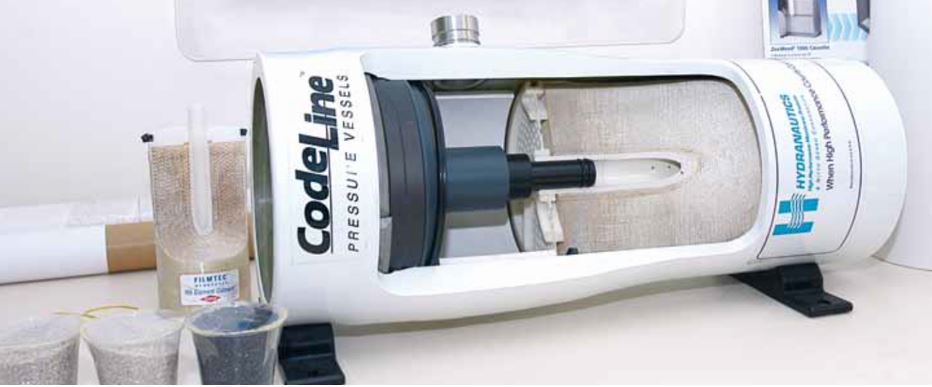
Membranes are wrapped up into tube-like shape and packed in a container
Ozone is a very strong oxidising agent. It has been widely used in water treatment to replace chlorine for oxidation of impurities, taste and odour control as well as disinfection. However, it cannot produce a lasting disinfectant residue in water. As the majority of Hong Kong people are living in high-rise buildings which results in taking a long time for the treated water from treatment works through to the roof tanks and then being supplied to the customers, a small amount of residual chlorine is still dosed into the water before leaving the water treatment works to keep the water free from contamination and maintain wholesomeness during its journey in the distribution system. This minimal amount of chlorine will disappear from water on boiling.
UV radiation is a form of electromagnetic radiation between 100 to 400 nanometres (nm) in the electromagnetic spectrum. It has disinfection effect at germicidal wavelengths of 200-300 nm. Disinfection using ultraviolet (UV) radiation has been more commonly used for waste water treatment, but today it is increasingly used for fresh water treatment. Researches and trials have revealed that this method of treatment is also effective for destroying micro-organisms like Cryptosporidium and Giardia. Hong Kong may consider adopting UV radiation in future new plants when it is justifiable.