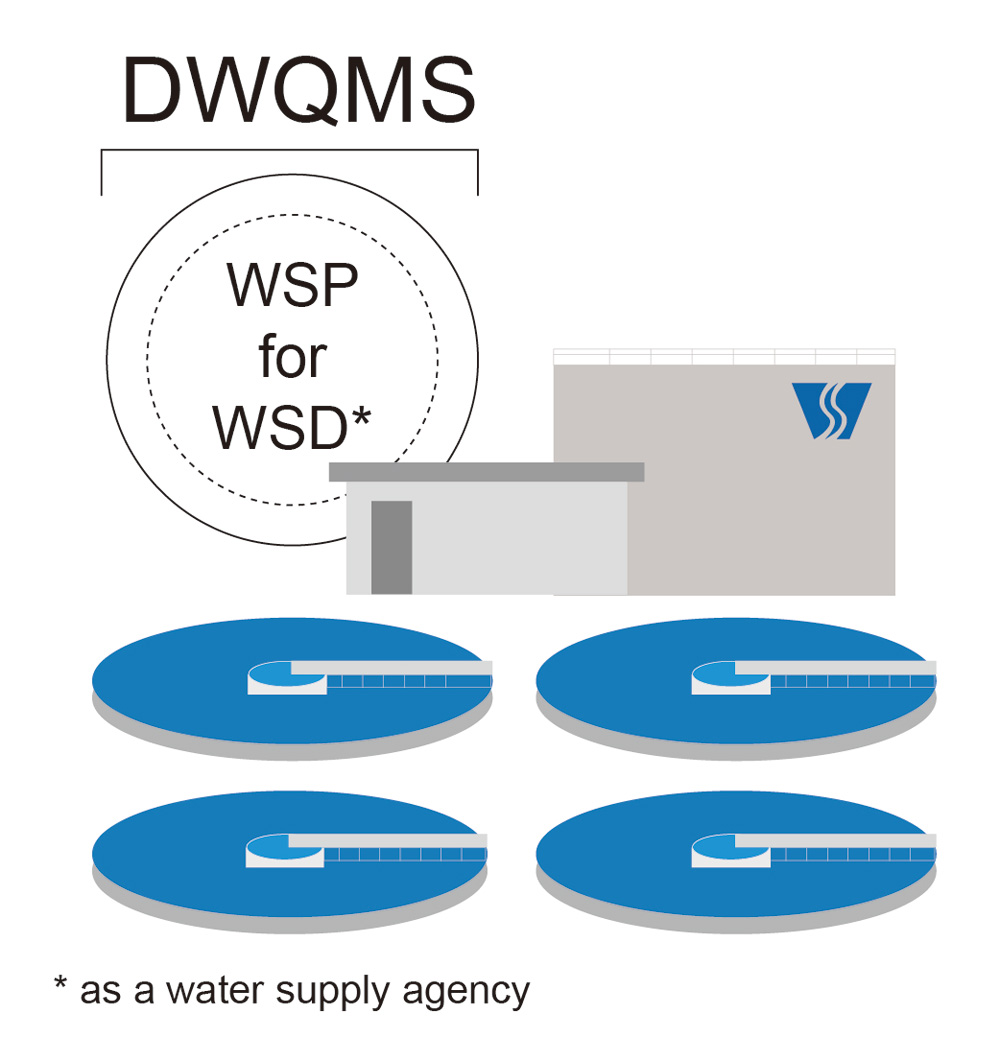
The WSP for the WSD has been incorporated as a central component of the DWQMS.

The World Health Organization (WHO) advocates the adoption of the Water Safety Plan (WSP) to ensure drinking water safety through risk management including identification of areas where potential contamination in the water supply system encompassing internal plumbing system may occur and devising appropriate control measures.

In 2007, WSD developed and implemented its own WSP following the WHO Guidelines to ensure drinking water quality from source to distribution. In regard to the inside services, WSD has spelt out in the WSP its regulatory, monitoring and advisory role.

Taking international experts’ recommendations into consideration, and referencing the overseas practice in Western Australia, WSD has decided to upgrade the plan by developing an integrated Drinking Water Quality Management System (DWQMS) in 2017.

The WSP of WSD is mainly covers the following aspects:

Protection of Water Gathering Grounds and Impounding Reservoirs

Resource and source protection is the first and foremost barrier in the protection of water quality. To prevent water pollution, wastewater must be treated to meet the relevant regulatory standards laid down in the Technical Memorandum on "Standards for Effluents Discharged into Drainage and Sewerage Systems, Inland and Coastal Waters” under the Water Pollution Control Ordinance.

Potential hazards to water quality may arise from natural factors such as heavy rainfall, drought, algal bloom and natural disasters as well as other factors such as agricultural activities like farming and livestock rearing; industrial activities and operation; changes of land use; residential developments; chemical spills; contamination incidents. Effective catchment management such as setting up a monitoring regime, control of land uses, activities and developments within water gathering grounds, regular inspections and enforcement of relevant ordinances and regulations as well can prevent the contamination of the source water, and thus can reduce the operational cost of water treatment required and the formation of disinfection by-products.

Water from Dongjiang

The management and control of Dongjiang’s catchments is within the jurisdiction of the Guangdong authorities such as the Department of Water Resources and the Department of Ecology and Environment of Guangdong Province. The WSD closely monitors the quality of Dongjiang water as received at the Muk Wu Pumping Station round the clock. The WSD also maintains a close liaison with these authorities, and through them, measures to protect the water quality are being taken.

For details, please visit Dongjiang Water Supply – Dongjiang Water Quality.

Water Treatment

A sludge thickening tank in water treatment works

The next barrier to the contamination of the water supply system is the water treatment process. The water treatment process is a key component in the multiple-barrier approach in removing the impurities, chemical and pathogenic organisms in water.

Potential hazards at this stage may arise from the sudden deterioration of raw water quality, inadequate chemical dosing, inadequate mixing of water and dosed chemicals, inadvertent use of substandard water treatment chemicals and power outage.

Control measures to prevent or minimise the risk of contamination at this stage include the adoption of reliable treatment process, quality control on the supply of chemicals and robust engineering design to increase the reliability of the system. Advanced water treatment technologies, such as ozonation and biological filtration, have been employed in Hong Kong. The treatment process in the water treatment works is optimised to remove the impurities including pathogenic organisms in order to ensure that the water quality consistently meets the preset critical limits.

The water quality at each stage of the treatment process is closely monitored by on-line water quality analysers and regular sampling for testing of key parameters such as pH value, turbidity, residual chlorine and fluoride. The on-line monitoring data can facilitate operational monitoring of process performance in timely adjustment of the treatment process to ensure the satisfactory quality of the treated water in response to changes of raw water quality.

Distribution System

The quality of the treated water that leaves the treatment works and enters the distribution system complies with the Hong Kong Drinking Water Standards. The design, operation and maintenance of the distribution system are vital to maintaining the good quality of the water supply.

Potential hazards may arise from a myriad of causes including backflow, improper commissioning of newly laid fresh water mains, defective pipe and solder materials, contamination events and vandalism. Procedures and practices are in place to manage, reduce and control the hazards that may affect the safety of the drinking water supply in the distribution system. For example, a newly laid fresh water main has to be properly cleansed, flushed and sterilised according to established procedures before putting to use.

Verification of Drinking Water Quality

Verification provides a final quality check and the efficiency of actions to ensure the overall safety of the water supply. In Hong Kong, the water quality throughout the entire supply and distribution chain is systematically monitored by regular sampling from different parts of the system for physical, chemical, radiological, bacteriological and biological examinations. The sampling points cover water gathering grounds, receiving points of Dongjiang water, impounding reservoirs, water treatment works, service reservoirs, distribution mains and consumers’ taps. The monitoring programme including sampling frequencies and scopes of analysis is reviewed regularly for comprehensive surveillance on the quality of water throughout the entire water supply system. The quality of drinking water supply in Hong Kong fully complies with the Hong Kong Drinking Water Standards and is perfectly safe for human consumption.

Plumbing System

WSD is responsible for supplying water to connection points at the land boundaries of buildings. The operation and maintenance of internal water pipes and all associated supply facilities is the responsibility of property management offices or registered service agents.

Water Safety Plan for Buildings Water Safety Plan Subsidy Scheme

Notwithstanding that the water supplied by Water Supplies Department (WSD) is safe to drink, the water quality could be affected in the internal plumbing systems due to various factors. In view of this, WSD has committed to promoting WSP to property owners and management agents on how to develop and implement water safety plan for buildings (WSPB) in accordance with the recommendations of the World Health Organization (WHO), and launch the "Quality Water Supply Scheme for Buildings – Fresh Water (Management System)” (the "Scheme”) to provide incentive to encourage property owners and management agents to participate in the Scheme to enhance water quality in their buildings.

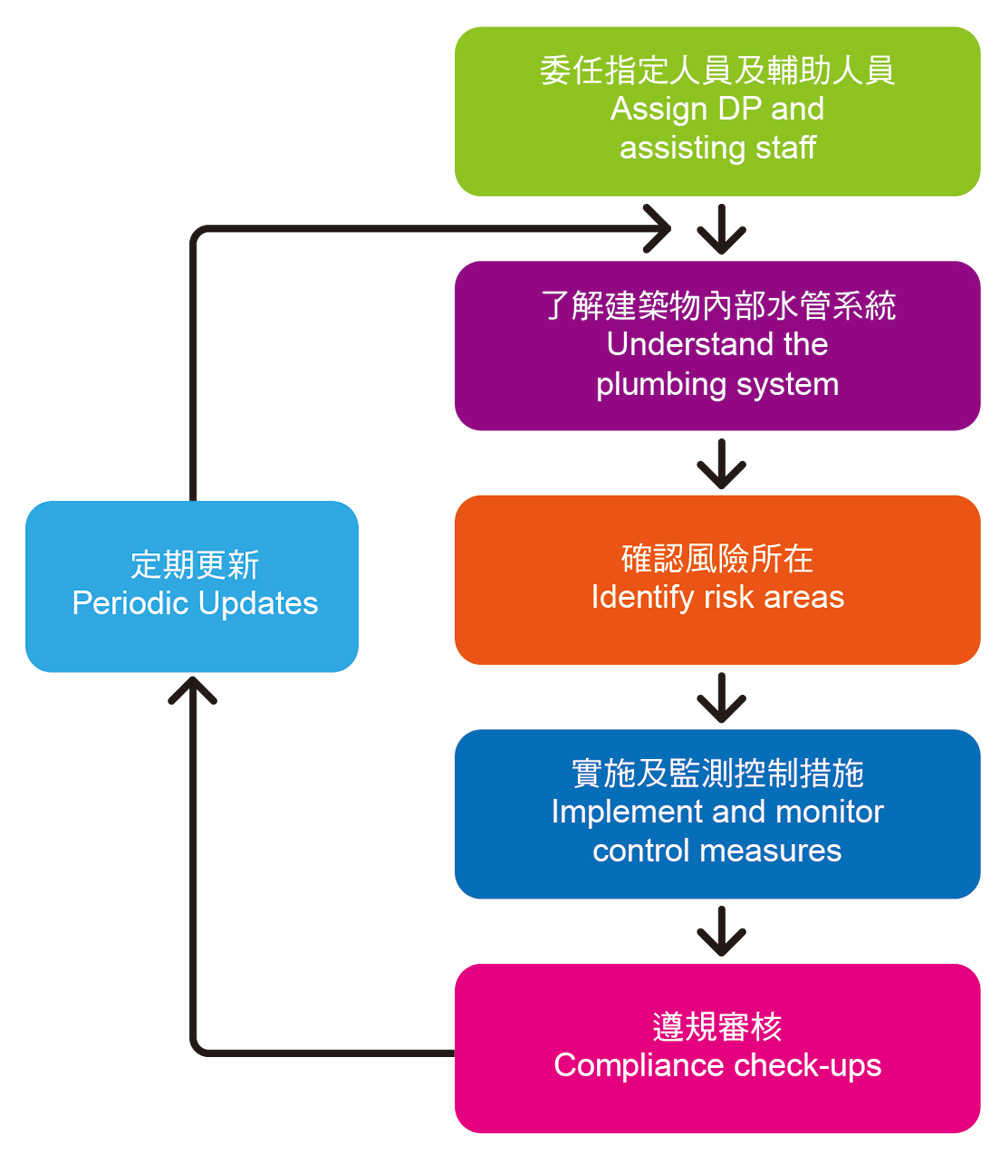
WSPB can be developed through the following steps:

  1. Understand the building’s internal plumbing system;
  2. Assess and identify areas in the internal plumbing system where there may be risks of contamination, e.g. water storage tanks could be contaminated by the ingress of foreign objects;
  3. Implement and monitor the corresponding control measures to prevent or reduce the occurrence of the associated risks, e.g. periodic inspection of water storage tanks to ensure that the covers are locked; and
  4. Perform periodic compliance check-ups to ensure that the WSP is implemented effectively.

Quality Water Supply Scheme for Buildings - Fresh Water (Management System)

To promote property owners’ and property management agents’ adoption of WSPB, WSD launched a new voluntary scheme "Quality Water Supply Scheme for Buildings – Fresh Water (Management System)” (QMS) by integrating WSPB with the "Quality Water Supply Scheme for Buildings – Fresh Water (Plus)” in 2017 to further safeguard the quality of drinking water in buildings.

The principal aims of the scheme are to:

  1. Promote to and assist property owners and property management agents to safeguard drinking water quality in their buildings through assessments of risks inherent to the internal plumbing systems, implementation of the corresponding control measures, regular inspection and maintenance of the internal plumbing systems together with regular audit and review of the WSPB;
  2. Raise the awareness of property owners, property management agents and customers of the importance of proper maintenance and the use of compliant materials for the internal plumbing systems;
  3. Enable the public and overseas visitors to have greater confidence of the water quality at the tap;
  4. Strengthen the capability of property management agents to achieve value-added performance in meeting the needs of customers with respect to quality of tap water; and
  5. Give recognition to property owners and property management agents who can demonstrate consistent compliance with the prescribed criteria under the Scheme.

The scheme is targeted at all property owners, owners’ corporations and property management agents. Participation is voluntary. A successful building will be awarded one of three grades (namely, blue, silver and gold, according to the length of the continuous period for which a building has joined the Scheme) of certificates to recognise proper maintenance of the internal plumbing systems. The certified party is entitled to use this certificate or its copy for display in the building, stationery and promotional materials, subject to the guidelines issued by WSD. This certification reflects a good quality of property management, signifying the building owners’ awareness of the importance of upkeeping the inside service in ensuring a quality water supply. That will not only help improve the living environment, but also promote a better image of the property when compared to those without the certificate. With this certification, residents’ confidence on tap water quality will be assured.

Blue Certificate – Sample

Silver Certificate – Sample

Gold Certificate - Sample

Do you know?

What should you do to take care of your flat's or building's plumbing system?

1. Clean water tanks
Cleaning all water tanks, both sump and roof top tanks, can prevent the accumulation of dirt which may lead to discoloured water. Tanks should be cleaned at least once every three months.

2. Employ a licensed plumber to install and regularly maintain water related equipment and appliances
Be sure to employ a licensed plumber to install or remove taps, pipes and fittings of internal plumbing system as well as install water related equipment such as water tanks, bath-tubs, appliances including washing machines and water heaters.

3. Replace old water pipes
Ensure that the replaced pipes and works meet recognised standards.

4. Use filters or purifiers appropriately
Some people will choose to install filters or purifiers in the tap of a flat or an office. However, the filter or purifier is required to clean and replace regularly to ensure their effectiveness. Failing that, they may become a source of contamination of the water supply.

The Chief Executive announced in the 2019 Policy Address the Government's plan to launch the Water Safety Plan Subsidy Scheme (WSPSS) to encourage property owners and management agents to implement the Water Safety Plan for Buildings (WSPB) at their premises to further safeguard drinking water safety in buildings in Hong Kong.

Private residential or composite building with the average annual rateable value of all the domestic units in the building not exceeding the specified ceiling is eligible for participating in the scheme. The scheme subsidises the formulation of WSPB including water safety risk assessment on the internal plumbing system of the building, the necessary rectification works for controlling the risks as identified in the water safety risk assessment as well as the implementation of WSPB during the first (first 2 years) and second (following 2 years) cycles.

A total of $440 million was allocated to the WSPSS for five years. It is envisaged to benefit about 5 000 eligible buildings. WSPSS has been opened for application from 13 July 2020.

The Importance of a Water Safety Plan

Within the local fresh water supply chain, there are 17 impounding reservoirs, 20 water treatment works and many water pumping stations. Treated water is pumped to service reservoirs for subsequent distribution to people. The WSP plays an important role to: