Water Safety
Relationship between Water Safety and Public Health
Water quality has profound impacts, not only on individual’s well-being, but also on public health. Contaminated water and poor sanitation are linked to the transmission of diseases in society. More specifically, poor microbiological quality of water will potentially result in outbreaks of infectious parasitic and water-related diseases or even lead to serious epidemics, such as cholera, dysentery, hepatitis A, typhoid, and polio. Water contaminated by chemicals could also impose significant impacts on health by causing chronic effects. Absent, inadequate, or inappropriately managed water and sanitation services expose individuals to undesirable health risks.
(Source: World Health Organization)
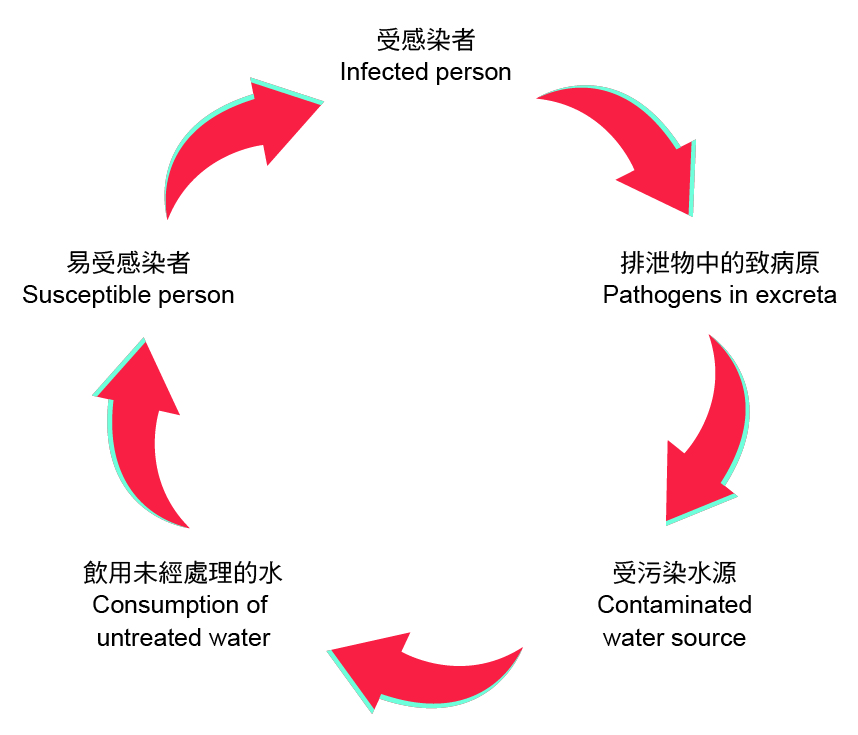
Waterborne Infection Cycle
(Source: Tebbutt, T.H.Y., 1992)
Waterborne Diseases
Waterborne diseases are caused by pathogens, including bacteria, viruses and parasites, and other environmental health hazards, which are directly transmitted to human beings when contaminated water is consumed. The most common diseases are diarrhoeal diseases. Some well-known examples of waterborne pathogens include Salmonella, Shigella, Campylobacter, Rotavirus, Enteroviruses, and Giardia. They may affect several people or an entire community, depending on the quantity or type of pathogens present in the water.
Do you know?
In 2010, the United Nations General Assembly explicitly recognised the human right to water and sanitation and acknowledged that clean drinking water and sanitation are essential to the realisation of all human rights.
Drinking Water Safety in Hong Kong
Hong Kong is one of the places in the world that enjoys the safest drinking water. Over the years, the Water Supplies Department (WSD) has been supplying drinking water in full compliance with the World Health Organization's Guidelines for Drinking-water Quality. With an aim to further safeguard the drinking water quality in Hong Kong, the Action Plan for Enhancing Drinking Water Safety in Hong Kong (Action Plan), which adopts a multi-pronged approach, is launched in September 2017. The Action Plan comprises five components:
Drinking Water Standards and Enhanced Water Quality Monitoring Programme

- Establishing the Hong Kong Drinking Water Standards with reference to the worldwide practices and in consideration of the local context.
- Collecting water samples from drinking taps of randomly selected consumers of the territory for testing with a view to monitoring the drinking water quality in the territory.
Plumbing Material Control and Commissioning Requirements of New Plumbing Installations

- Strengthening water safety in inside service through stringent control measures and guidelines over plumbing materials, design, construction and commissioning of new plumbing systems.
Water Safety Plans

- Ensuring drinking water safety through risk management including identification of areas where potential contamination in the water supply system may occur and devising appropriate control measures. For details, please visit Water Safety Plan.
Water Safety Regulatory Regime

- Reviewing Hong Kong's water safety regulatory regime and setting up an independent Water Quality Regulator to keep drinking water safe.
Publicity and Public Education

- Boosting consumers’ awareness of drinking water safety through various channels such as dedicated webpages, TV and radio announcement in the public interests, posters and leaflets, seminars, etc..
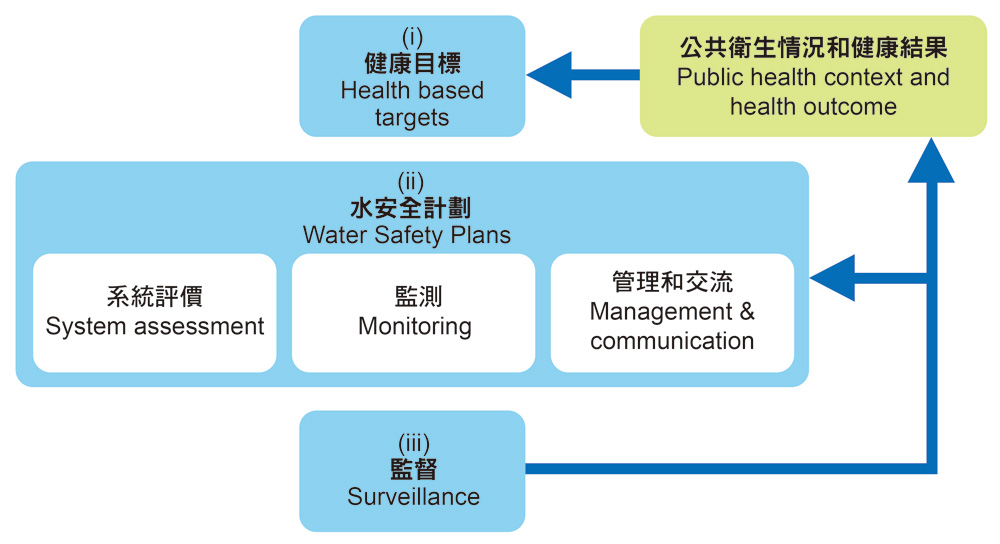 Framework for Safe Drinking Water introduced by World Health Organization in 2004
Drinking Water Quality Management System
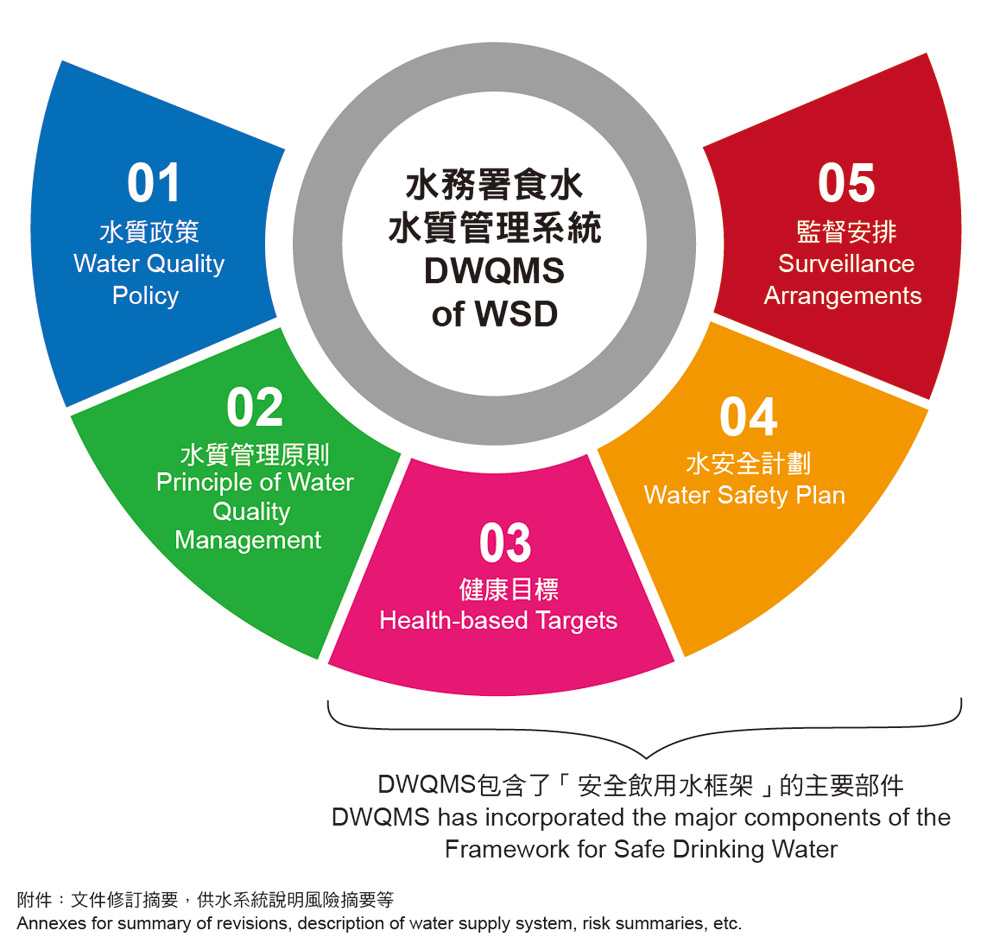
To assure the quality of drinking water for the protection of public health, WSD has implemented the Drinking Water Quality Management System (DWQMS), which was established with reference to the World Health Organization Guidelines.
Framework for Safe Drinking Water introduced by World Health Organization in 2004, there are three major components of the framework:
- Health-based Targets are derived based on an evaluation of health risks from drinking water.
- Water Safety Plan (WSP) serves as the management tool to assist in meeting the Health-based Targets via using a risk-based and multiple barrier approach. WSP comprises three essential elements, including system assessment, monitoring and management & communication.
- A system of independent surveillance that verifies the fulfilment of the Health-based Targets and proper implementation of the WSP based on public health context and health outcome.
WSD has developed and implemented the WSP of WSD since 2007 to safeguard the quality of water supply. WSD has reviewed the departmental WSP in 2017 and further enhanced the plan by developing an integrated Drinking Water Quality Management System (DWQMS) of WSD based on international experts’ recommendations as well as the overseas practice in Western Australia. Document Structure of the DWQMS as follow: